SCOTCAT.COM
your internet guide to all things catfish
FACTSHEETS: June 2005 - no. 108
Synodontis congicus Poll, 1971 |
Synodontis congicus
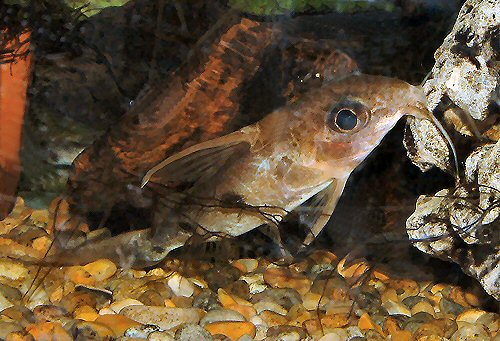
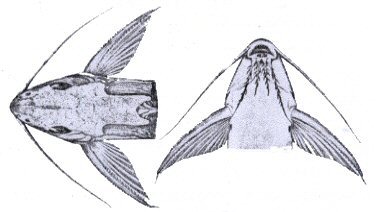
To start of with, the number of spots on the two species of S. congicus and S. notatus does not warrant any attention as they do vary with my 4 species of S. congicus showing 4 spots and 3 spots. The main criteria for the 2 species is the length of their maxillary barbels (pertaining to the upper jaw). S. congicus has short maxillary barbels reaching back to just after the insertion of the pectoral fin whereas S. notatus has them longer, reaching to nearly the end of the pectoral fins, which can be seen in the accompanying line drawings. S. congicus has also a shorter snout. Another very important feature is the adipse fin, S. notatus being very small and S. congicus being the larger of the two. S. congicus tends also to have a larger eye much as in the vain of S. pleurops but not as large.
Synodontis congicus
Another look-alike species that I havent mentioned and is a bit rarer in the hobby is Synodontis nummifer which has short barbels like S. congicus but has a spotted head and pigment in the caudal fin. The thing about all three of these species is that their humeral process (Bony extension of the pectoral girdle) are quite alike in that they are all blunt with S. congicus being a little bit shorter and the head shield being heavier, but this is not a good way to identify these 3 species in that you may be looking at juveniles and this method may not be fool proof.
Synodontis congicus
Synodontis notatus
(Drawings from) Poll, Max; Revision Des Synodontis Africains (Famille Mochokidae) 1971.
Keeping Synodontis congicus is not too much of a problem. They do like, as most Synodontis, to be territorial but not as bad as S. notatus which can be a bit disruptive when they get to adult size. They will get on fine with each other if they are introduced as juveniles or young adults. They will have a few skirmishes, but nothing too drastic. They do tend to be quite shy but they will venture out for food during the day and dart back into their hiding places with their catch. As you have noted they are much happier kept in a tank when they have choices of shelter during the day, whether it is pipework, branches/bogwood or stonework/slates.
|
 have
decided this month to return to the African Continent
and to concentrate my thoughts on a member of the
Synodontis genus which has been misidentified
on a number of occasions in your local fish store.
The catfish in question is the "Congo Synodontis",
Synodontis congicus and its similarity to
another species from the same area,
have
decided this month to return to the African Continent
and to concentrate my thoughts on a member of the
Synodontis genus which has been misidentified
on a number of occasions in your local fish store.
The catfish in question is the "Congo Synodontis",
Synodontis congicus and its similarity to
another species from the same area, 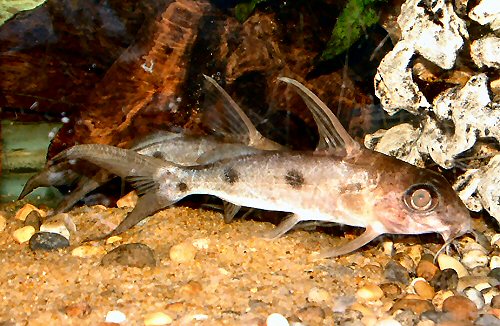

Common Name |
Congo Synodontis |
Synonyms |
None |
Family |
Mochokidae |
Subfamily |
Mochocinae |
Distribution |
Africa: Democratic Rep.of the Congo. Congo basin (except Lower Congo, central basin, Luapula-Moero and High Katanga). |
Size |
18.0cm (7ins) |
Temp. |
22-25°C (71-77°F) |
p.H. |
6.5-7.5. |
Characteristics |
Dorsal 1/7 with a short filament. Adipose fin base 1/7. Short maxillary barbels reaching back to just after the insertion of the pectoral fin. Large eye. Short and rounded humeral process. |
Colouration |
Light grey to silver with one to four black spots along midlateral line of body. |
Aquarium Care & Compatibility |
| Best suited to the larger aquarium. A quite well behaved Synodontis if given the room to grow and will not molest tankmates if they are not too small. |
Reproduction |
No reports on the breeding of this species. |
Diet |
| Will eat a variety of foods and as in most members of this genus they are not a problem to feed. Tablet and pellet foods with a good quality flake and frozen bloodworms. |
Etymology |
| Synodontis:
Syn = together; odontis = teeth
(fused tooth plates). |
References |
Poll,
Max; Revision Des Synodontis Africains (Famille
Mochokidae) 1971. |
Photo Credits |
©
Allan James @
|

|

If you would like to contribute to the monthly factsheets with an article, information or photos, please e-mail me. You will of course be credited for your work.
If you would like to donate any denomination of money to the site just click the above link button. All proceeds will go to running the site and hopefully to keep it going for a few years yet.
ScotCat Sources
 Etymology-genera
Etymology-specific name
Other Sources
 Search
 Fishbase
 Wikipedia
 Catalog
of Fishes
Catalog
of Fishes
 GBIF
GBIF
 iNaturalist

