SCOTCAT.COM
your internet guide to all things catfish
FACTSHEETS: May 2010 - no. 167
Scleromystax sp. (C112) |
|
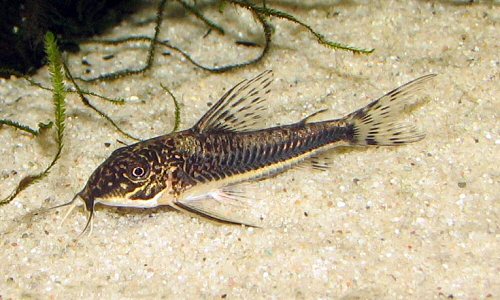
Scleromystax sp. (C112)
In addition, Scleromystax differs from Aspidoras in its reduced ossified portion of pectoral spine, which is longer than half the length of the first branched pectoral-fin ray, and in its somewhat more elongate snout. Individuals of this genus also posses a conspicuous colouration pattern characterized by small striated blotches all over dorsum and sides of head (less conspicuous in Scleromystax prionotos). There are at the present (May 2010) the six named Scleromystax species, S. barbatus, S. kronei, S. lacerdai, S. macropterus, S. prionotos and S. salmacis. There is also two c-numbers, this species C112, C113 and also two CW number CW038 and CW042 waiting for a description.
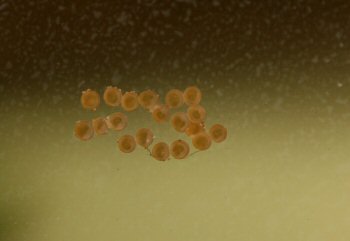
.Scleromystax sp. (C112) - eggs
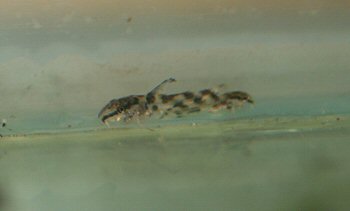
Scleromystax sp. (C112) - six weeks old
The Scleromystax genera was resurrected by taxonomists (Britto; Marcelo R. Phylogeny of the subfamily Corydoradinae Hoedeman, 1952 (Siluriformes: Callichthyidae), with a definition of its genera) during an ongoing study of Corydoras, Aspidoras and Brochis in 2004. The main criteria for resurrecting the genera was the cheek bristles on the males.
Remarks: The genus Scleromystax belongs to lineage 3 and if there was a revision carried out on the Corydoradinae in the future they would remain so, with the designated type species S. barbatus (Günther, 1864).
|
 his
member of the Callichthyidae genus has not been named
to species and as such are known in the trade as Scleromystax
‘Baianinho II’. Scleromystax
species are found in the rainforest streams, and not
in the open river areas. This genus is related more
to the Aspidoras than the Corydoras
genera. As this genera are found on the south east
coast of Brazil they will do better at lower temperatures.
his
member of the Callichthyidae genus has not been named
to species and as such are known in the trade as Scleromystax
‘Baianinho II’. Scleromystax
species are found in the rainforest streams, and not
in the open river areas. This genus is related more
to the Aspidoras than the Corydoras
genera. As this genera are found on the south east
coast of Brazil they will do better at lower temperatures.
Common Name |
C112, Baianinho II |
Synonyms |
None |
Family |
Callichthyidae |
Subfamily |
Corydoradinae |
Distribution |
South America: Brazil, São Paulo State. |
Size |
Male: 8.0cm (3¼ins) Female: 7.5cm (3ins) |
Temp. |
20-25°C (67-77°F) |
p.H. |
6.0-7.2. |
Characteristics |
Lateral ethmoid long; contact between supraoccipital and nuchal plate; palatine slender; odontodes on preopercular-opercular region of males. |
Colouration |
Males have a light brown body with reticulated markings to the head. There is a darker band running the full length of the body on the lateral line. Below this the body is cream coloured. Females are more plain and tend to have the dark band broken up in sections and the cream colour of the underside is less defined. In the females there are also about three small gold flecks along the lateral line. |
Aquarium Care & Compatibility |
| As with most members of the Callichthyidae they are peaceful and good additions to the larger "cool water" aquarium set up with maybe other cool water fish such as White Cloud Mountain Minnows and other fish that are comfortable with a temperature around the 70°f (21.5°c) mark. |
Reproduction |
As per the Corydoradinae sub family with the males chasing the females and clinching in the time honoured T-position. They will lay their eggs medium to high up on the glass and are easily rolled off with your fingers and placed in a small container to hatch and then when they use up their yolk sac they can be fed very small first foods such as Liquifry no.1 and then on to fry flake and micro worm and tablet food. I added an airline to this container to move the water around gently. |
Sexual Differences |
The pectoral fins are longer in the males as in the the females. They also have bristles on the snout which are very hard to distiguish. The males are also better marked and coloured. |
Diet |
| As with other members of the Corydoradinae they relish tablet and good quality flake food with frozen bloodworm a firm favourite. They are also keen on chopped earthworms and other worm foods such as white worm used sparingly, and grindal worm. |
Glossary of Terms |
| Nuchal
plate: Area
between the skull and dorsal fin. |
Etymology |
| Scleromystax: From the Greek "sclero" meaning hard and the Latin "mystax" meaning moustache. |
References |
Alexandrou,
Markos & Taylor, Martin. (2011). Evolution,
ecology and taxonomy of the Corydoradinae revisited.
|
Photo Credits |
| Top: © Graham
Ramsay |

|

If you would like to contribute to the monthly factsheets with an article, information or photos, please e-mail me. You will of course be credited for your work.
If you would like to donate any denomination of money to the site just click the above link button. All proceeds will go to running the site and hopefully to keep it going for a few years yet.
ScotCat Sources
 Etymology-genera
Online Sources
 Search

