SCOTCAT.COM
your internet guide to all things catfish
FACTSHEETS: May 2009 - no. 155
Rineloricaria latirostris (Boulenger, 1900) |
Rineloricaria latirostris
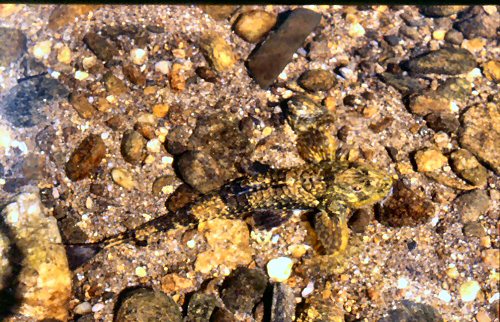
In 1862 Bleeker in his description of Rineloricaria also mentioned Hemiloricaria and it is now ascertained that the latter occur in the warmer climes of South America and Rineloricaria hail from the southeastern and southern half of South America. Alongside the Ancistrus spp. this genus is another that needs a complete revision to sort them out. The problems have been that a lot of the Rineloricaira spp. were described in the last century and only loose locations were assigned to each species. This species is very good at camouflage and the bottom image shows you the cryptic colours that it can take on to merge with the substrate and surroundings.
Showing its cryptic colouration
They live in the flowing mountain streams of the rain forrest so temperatures in the low end of the tropical scale would be better, especially for breeding purposes. The species that has been bred more often under this name is Rineloricaria sp. aff. latirostris which occurs near the city of Rio de Janeiro and as such is easier to export.
|
 his
month (May, 2009) we stay with the Loricariidae family
and concentrate on a cooler water Pleco in the "Bristly
whiptail catfish" Rineloricaria latirostris.
his
month (May, 2009) we stay with the Loricariidae family
and concentrate on a cooler water Pleco in the "Bristly
whiptail catfish" Rineloricaria latirostris.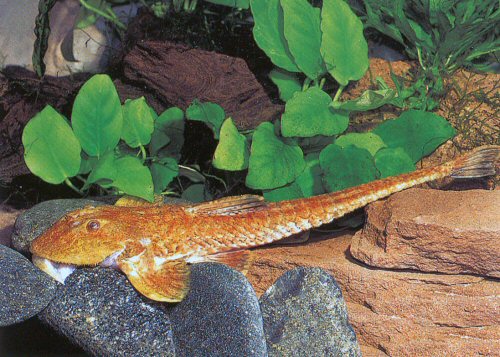
Common Name |
Bristly whiptail catfish |
Synonyms |
Loricaria latirostris, Loricaria paulina, Rineloricaria paulina |
Family |
Loricariidae |
Subfamily |
Loricariinae |
Distribution |
South America: Upper Paraná River basin.: Type locality: Southern Brazil, Province São Paulo, Mogy-guassu River about 250 miles inland of Santos. |
Size |
20.0cm. (8ins) |
Temp. |
18-22°c (63-71°f) |
p.H. |
6.0-7.0. |
Characteristics |
Dorsal fin opposite to the base of the pectoral fins. Papillae and a protrusion of the lips. Bicuspd teeth with pointed tips. |
Colouration |
Cryptic pattern to its surroundings based on a cream/yellow boby colour. Belly white. |
Aquarium Care & Compatibility |
Reproduction |
If you are thinking of spawning them a separate tank kitted out with PVC pipes (not too large) for the placement of eggs would be a better option than a community tank, although growing on a few in the main tank from youngsters would suffice as they can be difficult to sex out when young and only when they get sexually mature that you tell the sexes apart. Articles on the breeding of Rineloricaria spp. can be found in the breeding article section of ScotCat and can be viewed here and here. |
Sexual Differences |
Difficult when young but sexually mature males take on small bristles to the cheeks and head area. The female is devoid of this. |
Diet |
| Omnivorous species but likes a good bit of vegetable fare in their diet. |
Glossary of Terms |
Bicuspd teeth:
Ending in two points; a tooth with two cusps
or points. |
Etymology |
| Rineloricaria:
Rhine = file; loricara = harness. |
References |
Evers,
H.-G. & Seidel, I:
Mergus, Baensch Catfish Atlas Volume 1, 1st English
edn., 2005. Pp.944. |
Photo Credits |
© Hans-Georg Evers |
|

If you would like to contribute to the monthly factsheets with an
article, information or photos, please e-mail
me. You will of course be credited for your work.
If you would like to donate any denomination of money to the site just click the above link button. All proceeds will go to running the site and hopefully to keep it going for a few years yet.
ScotCat Sources
 Etymology-genera
Etymology-specific name
Online Sources
 Search
 Fishbase
 Catalog of Fishes
 GBIF
GBIF
 iNaturalist

