SCOTCAT.COM
your internet guide to all things catfish
FACTSHEETS: October 2007 - no. 136
Rama chandramara (Hamilton, 1822) |
Rama chandramara
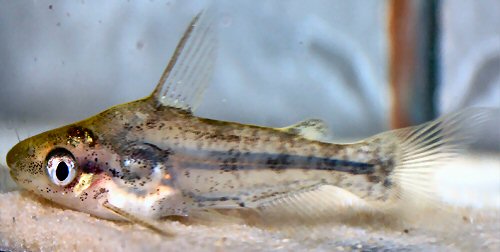
The adipose fin in R. Chandramara is much smaller than in any species of Batasio and oar-like (a character independently shared with Neotropius and schilbeids), and the genus is further diagnosed by the presence of a prominent anterolateral process of the pelvic girdle (absent in all Batasio species), and fewer vertebrae (32–34 v. at least 35). In India the common name for this species is the 'Asian Cory' probably pointing to the steep head, to the insertion of the dorsal fin, which is reminicent of the Corydoras genus of South America. Depending on the substrate Rama chandramara will sport different colour patterns as you can see from the two images: the above on a dark base and below on a sand base. In its own environment it inhabits, ditches, streams and canals.
Rama chandramara - on a sand substrate
This is not the easiest species to keep in the aquarium and can prove delicate. Good water quality is a must to be able to enjoy this small Bagrid to the full. Tank decorations would be a planted aquarium with hiding places to make it feel more comfortable in its surroundings. Will be happier if you can keep them in groups of at least four as they will do better in their own company. Remarks: This species can be found on online searches, as Chandramara chandramara or Rama rama, but Eschmeyer's Catalog of Fishes has Rama chandramara as valid (2023). |
 hen you think of the members
of the Bagridae family your mind wanders to the big
and nasty boys like
hen you think of the members
of the Bagridae family your mind wanders to the big
and nasty boys like 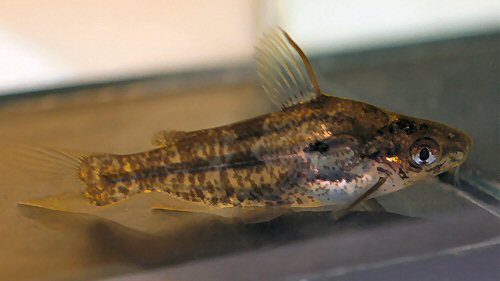
Common Name: |
Hummingbird Catfish, Asian Cory |
Synonyms: |
Pimelodus chandramara, Rama rama, Pimelodus rama, Leiocassis rama, Chandramara chandramara |
Family: |
Bagridae |
Subfamily: |
- |
Distribution: |
Asia: Base of eastern part of Himalaya, and Sarda River basin. Type locality: Atreyi River, India. |
Size: |
5.5cm. (2¼ins) |
Temp: |
18-22°C (63-71°F) |
p.H. |
6.5-7.2. |
Characteristics |
Body short, compressed, abdomen rounded. Head small, compressed. Snout obtusely rounded. Mouth subterminal, moderately wide. Eyes large, inferior (visible from below ventral surface of the head). Jaws subequal. Lips thin, plain, may be fimbriated or with sensory pores. Teeth on jaws and palate in broad villiform bands. Four pairs of barbels; one each of maxillary, nasal and two of mandibular, all slender, shorter than head, may be coloured. Caudal fin forked, lobes equal. Lateral line complete, with a few pores above pectoral fin base. |
Colouration |
Yellowish body speckled with dark to light brown spots. Broad dark brown lateral line with two other thiner lines above and below. All fins hyaline with dark first hard rays. |
Aquarium Care & Compatibility |
| Like the South American Corydoras they are also peaceful and and would do fine in a community aquarium with smaller compatriots such as small Tetras and Rasboras. |
Reproduction |
Not reported |
Sexual differences |
Females are heavier looking and the males are more slender and have an elongate genital papilla in front of the anus. |
Diet |
| They do prefer live food such as white worm and tubifex but will also accept frozen food such as bloodworm. |
Glossary of Terms |
Anterolateral:
Pertaining to the direction or position between the
front and side of an object. |
Etymology |
| Rama:
Named after the legendary Indian king
regarded as an incarnation of Vishnu.
|
References |
Jayaram,
K.C., The
Fresh Water Fishes of the Indian Region. Narendra
Publishing House, 1999. |
Photo Credits |
Top: © Allan James
@ |

|

If you would like to contribute to the monthly factsheets with an article, information or photos, please e-mail me. You will of course be credited for your work.
If you would like to donate any denomination of money to the site just click the above link button. All proceeds will go to running the site and hopefully to keep it going for a few years yet.
ScotCat Sources
 Entomology-genera
Entomology-specific name
Other Sources
 Search
 Fishbase
 Wikipedia
 Catalog
of Fishes
Catalog
of Fishes
 GBIF
GBIF
 Fishnet2
 iNaturalist

