SCOTCAT.COM
your internet guide to all things catfish
FACTSHEETS: March 2006 - no. 117
Pangasianodon hypophthalmus (Sauvage, 1878) |
|
his month we welcome back regular U.K. contributor Chris Ralph with his insight on the "Iridescent Shark", Pangasianodon hypophthalmus , and his trepidation on keeping this large catfish in the home aquarium.
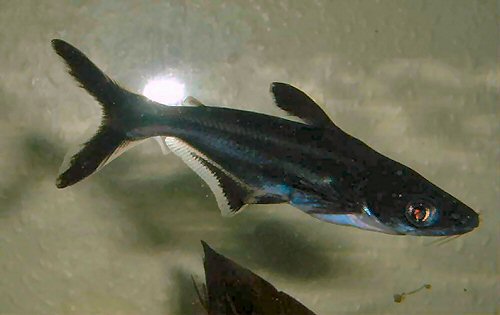
Pangasianodon hypophthalmus
A couple of years ago whilst on a day out with Kate looking at some aquatic retailers we were horrified to find that this catfish was being offered as the fish of the week on a buy one get one free basis. Needless to say we shall not be venturing back to that retailer. If only these catfish remained small and manageable, but alas they do not. These catfish are bred commercially in large ponds for the aquarium trade, which begs the question why? Obviously there is a demand or else this trade would not exist, how we control the importation of these fish is another story! Who in their right mind would want to keep a catfish that is capable of weighing in excess of 44kg?
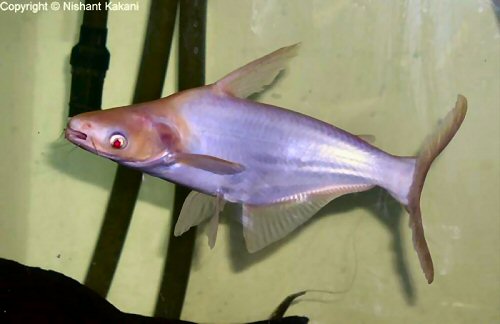
Pangasianodon hypophthalmus - albino
There is also an albino form of this catfish which is also offered for sale. It is documented that this is a migratory species of catfish moving upstream to spawn in May-July. This fish has been introduced to other countries other than those documented below which include Bangladesh, Philippines, Singapore and Taiwan. Aquarium size would need to be as large as possible but as an absolute minimum for a 450mm specimen I would suggest a 72” x 24” x 24” aquarium, even though I do not advocate the keeping of these catfish.
|

Common Name |
Iridescent Shark, Sutchi catfish or Pla Sawai |
Synonyms |
Pangasius pangasius, Helicophagus hypophthalmus, Pangasius pleurotaenia, Pangasius sutch, Pangasius hypophthalmusi |
Family |
Pangasiidae |
Subfamily |
- |
Distribution: |
Southeast Asia: Namely the Mekong, Chao Phyra and perhaps Mekong basins; Thailand, Laos, Cambodia and Viet Nam. It is documented that this catfish has been introduced into additional river basins for the purposes of aquaculture. |
Size |
1300mm or 52” SL (standard length is the measurement from the tip of the snout to the base of the caudal peduncle). |
Temp. |
The ideal temperature range is 22-26°C. |
p.H. |
The ideal range is 6.5-7.5 |
Hardness |
2-29°dGH |
Characteristics |
The body is best described as being elongated. The position of the mouth is described as being terminal. There are 6 branched dorsal fin rays and the pelvic fins have 8-9 soft rays. The gill rakers are described as being normally developed, with small gill rakers being interspersed with larger ones. |
Colouration |
The fins of this catfish are dark grey or black in colour. Juvenile specimens are described as having a black stripe along the lateral line with a second long black stripe below the lateral line. Adult fish are described as being uniformly grey in colour. These catfish have a dark stripe on the middle of the anal fin and a dark stripe in each of the caudal lobes. |
Aquarium Care & Compatibility |
| Whilst this catfish is fairly peaceful avoid keeping it with small fish as they will eventually appear on the menu. It is best to keep this catfish with other large fish avoiding those species that are too boisterous. |
Reproduction |
There are no known records of aquarium spawnings of this catfish, which is most likely due to the adult size of these fish and the enormous size of aquarium required. To be honest it is quite a relief that these fish have not been bred in aquarium conditions. |
Sexual Differences |
It is documented that the males have darker stripes and are more slender than the females. |
Diet |
| This catfish is best described as being an omnivore feeding on a mixed and varied diet that includes catfish pellets, catfish tablets, frozen bloodworm, floating food sticks and vegetable matter to name but a few. |
Glossary of Terms |
Gill
rakers:
Structure
on the upper portion of the gill arches. |
Etymology |
| Pangasianodon:
Pangasius +
an (Greek for without)+odon (Greek for tooth); in
reference to the toothless state of the adult fish. |
References |
Baensch,
H.A. and R. Riehl 1985 Aquarien atlas. Band
2. Mergus, Verlag für Natur- und Heimtierkunde
GmbH, Melle, Germany. 1216 p. |
Photo Credits |
Top: © Leigh
Murphy |
|

If you would like to contribute to the monthly factsheets with an article, information or photos, please e-mail me. You will of course be credited for your work.
If you would like to donate any denomination of money to the site just click the above link button. All proceeds will go to running the site and hopefully to keep it going for a few years yet.
ScotCat Sources
 Article
Article
 Etymology-genera
Etymology-specific name
Online Sources
 Search
 Fishbase
 Wikipedia
 Catalog of Fishes
 GBIF
GBIF
 Fishnet2
 iNaturalist

