SCOTCAT.COM
your internet guide to all things catfish
FACTSHEETS: April 2003 - no. 082
Phractocephalus hemioliopterus (Bloch & Schneider, 1801) |
|
Phractocephalus hemioliopterus
This is where the similarity ends as this is an out and out predator that grows over three feet and is definitely not recommended to your average aquarist and can only be recommended to the more experienced hobbyist who would be willing to dedicate, him or herself, to rearing this Amazon cat through the many tank changes from the juvenile stage to the the 3ft plus that it will attain throughout its long lifetime. Phractocephalus hemioliopterus occurs in the main river systems of South America in the Amazon region including the Rio Negro and other large river pools. This striking looking cat is definitely a loner in a home aquarium setup and would quickly kill any tank mates including any larger fish that was housed with it. You may think that so far this factsheet is very negative but I am just pointing out the pitfalls if you were not familiar with this wonderful looking South American beauty. You would be better to visit the establishments that can keep this Pim on view and if you live in the U.K. I would recommend visiting the Blue Planet Public Aquarium in Chester, England.
Phractocephalus hemioliopterus
They will grow quite rapidly and you would need to be prepared to upgrade to larger tanks as they grow. The problem with this of course is the moving and the stress involved in transporting a large fish to another tank and of course you would need to make sure that the water parameters are the same and the nitrogen cycle completed before the move. You would need to use at least 50% of water from the old tank to the new and seed the external power filter with material from the older one, if you are upgrading the filtration system. The larger the "Red Tailed Cat" gets the less clutter you need in the aquarium with probably a few large branches for decor and gravel if so desired, but you will probably find that they will move the gravel from one end of the tank to the other anyway. The problem you have in the latter stages of development is the size of your tank as you would need at least an 8ft tank with a width of about 36ins so that it can turn comfortly. The height is not so much a concern, with 18-24inch being ample. If this hasn't put you off you must be keen!. On the plus side (is there a plus side I hear you ask!) they make good pets and will eat out of your hand and can quickly become a member of the family where most other fish can't even reach this exalted status.
|
 he
common name of the "Red Tailed Catfish"
is probably better known than its scientifiic name
as this is one of the few freshwater tropical fish
that has its common name known wordwide along with
the humble community fish of the Poecilidae family,
the "Guppy", "Molly", and "Platy".
he
common name of the "Red Tailed Catfish"
is probably better known than its scientifiic name
as this is one of the few freshwater tropical fish
that has its common name known wordwide along with
the humble community fish of the Poecilidae family,
the "Guppy", "Molly", and "Platy".
Common Name |
Redtail Catfish |
Synonyms |
Silurus hemiliopterus, Phractocephalus bicolor |
Family |
Pimelodidae |
Subfamily |
Pimelodidinae |
Distribution: |
South America: Amazon and Orinoco River basins |
Size |
100cm. (36ins) |
Temp. |
20-26°C (67-79°F) |
p.H. |
6.0-7.0. |
Hardness |
Up to 10dGH |
Characteristics |
Dorsal fin 1:7; 3 pairs of barbels, the maxillary barbels do not extend much beyond the dorsal fin. Broad emarginate caudal fin. The pectoral fin spine is as thick as the dorsal ray spine. |
Colouration |
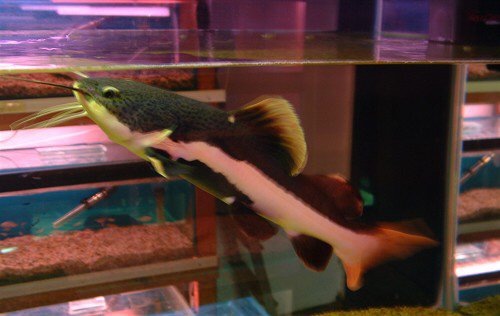
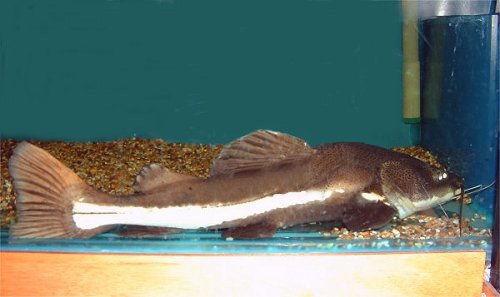
Orange to red caudal fin. Orange/yellow tips to the dorsal and ventral fins. Underside white with a broad white band starting from behind the gills to the caudal peduncle. Body colour brown with black spotting to head area. |
Aquarium Care & Compatibility |
| Here is a guide to keeping Phractocephalus hemioliopterus, the "Red Tailed Catfish", if bought as a one to two inch juvenile, can be housed in a smaller aquarium such as a 24" x 12" x 12" to start of with, and again you will only be able to keep one to a tank, as when even young they can be aggressive. Provide shelter in the tank to give them a bit of confidence and watch the water quality as they can be susceptible to ammonia and nitrite levels which will quickly erode their barbels, and also fit a cover to your heater to stop them resting against it and burning themselves. The choice of substrate is not important and you can dispense with this if you wish. External filters are best for this system and the bigger the better. Don't have too much bright lighting as they do prefer a more subdued light and alongside caves or branches they will feel more comfortable. |
Reproduction |
No instances have been recorded as yet owing to their adult size and the swmming area that would be needed. If there was to be a breeding project a Public Aqaurium would be the place intended or ponds in warmer climates. |
Diet |
| Can be fed on small feeder goldfish but it would be better to guide them of live food and feed them frozen bloodworm and earthworms when young. Adults and juveniles do like earthworms and other meaty foods such as prawns and crabs. Tablet and large pellet food is also greedily taken. Feed twice daily to young Redtails and then down to one feeding a day, 6 days a week, when they reach the juvenile stage. Adult Redtails can be fed a large meal once or twice a week only and the rest of the days to digest their meal. |
Etymology |
| Phractocephalus: Protected head. |
Glossary of Terms |
Ammonia:
A compound of nitrogen and hydrogen with the formula
NH3. |
References |
Baensch, H.A.
and R. Riehl, 1985. Aquarien atlas. Bd. 2.. Melle:
Mergus, Verlag für Natur- und Heimtierkunde,
Germany. |
Photo Credits |
© Allan James
@ |
 courtesy of
|

If you would like to contribute to the monthly factsheets with an article, information or photos, please e-mail me. You will of course be credited for your work.
If you would like to donate any denomination of money to the site just click the above link button. All proceeds will go to running the site and hopefully to keep it going for a few years yet.
ScotCat Sources
 Etymology-genera
Online Sources
 Search
 Fishbase
 Wikipedia
 Catalog of Fishes
 GBIF
GBIF
 Fishnet2
 iNaturalist

