SCOTCAT.COM
your internet guide to all things catfish
FACTSHEETS: December 2005 - no. 114
Oxydoras niger (Valenciennes, 1821) |
|
The Mother of Snails Catfish is not a very commonly seen doradid, although if you have kept one then it is one that you will not forget in a hurry due to the size that they can grow to. These catfish are usually offered for sale as juvenile specimens at around 4” in length. To the unsuspecting aquarist they have probably taken on more than they bargained for! This said if you are a genuine enthusiast you would already know a bit about these fish and their requirements prior to their purchase. The colour of these fish is basically dark brown to black, hence their other common name name "Black Doradid".
Oxydoras niger
If you own one of these catfish you will know that feeding time can be a rather wet experience, even with tight fitting cover glasses, or in my case an open topped pond! I have lost count of the number of soakings that I have had over the years! I purchased my first Mother of Snails Catfish about twenty years or so ago. The first one that I owned was around 10” long SL (25cm) and very rapidly outgrew a 72” x 18”x 18” aquarium. I eventually purchased a larger aquarium 72” x 24” x 36” and went on to keep this fish for a number of years. When the fish died from a bacterial infection it was almost 28” in length, and would have required an even larger aquarium before too long. This was really the main reason behind the construction of the Tropical Pond, although at present I am not keeping any large catfish. The Mother of Snails Catfish belongs to the Family Doradidae, all of which originate from various locations throughout South America.
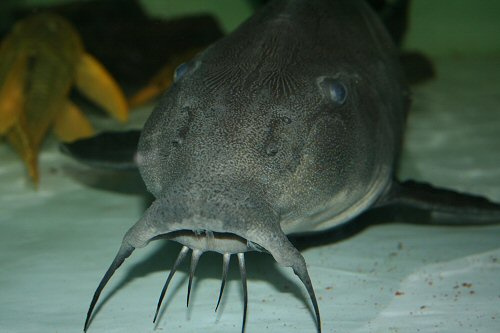
Oxydoras niger - head view
Sometimes literature refers to the doradids as “Talking Catfish” due to the fact that they can be heard to make audible noises, almost as if they are speaking to one another. There have been no records of these catfish having been successfully bred under aquarium conditions yet, which is probably just as well!
|
 n
this, the last month of 2005, we welcome back Chris
Ralph a regular contributor to ScotCat and who also
writes for the largest circular fishkeeping magazine
in the U.K., "Practical Fishkeeping". He
is also an author in his own right with a few books
now on the hobby. Without further ado Chris will explain
the doe's and don'ts of keeping one of my own favourite
big cats, Oxydoras niger, the "Mother
of Snails Catfish".
n
this, the last month of 2005, we welcome back Chris
Ralph a regular contributor to ScotCat and who also
writes for the largest circular fishkeeping magazine
in the U.K., "Practical Fishkeeping". He
is also an author in his own right with a few books
now on the hobby. Without further ado Chris will explain
the doe's and don'ts of keeping one of my own favourite
big cats, Oxydoras niger, the "Mother
of Snails Catfish".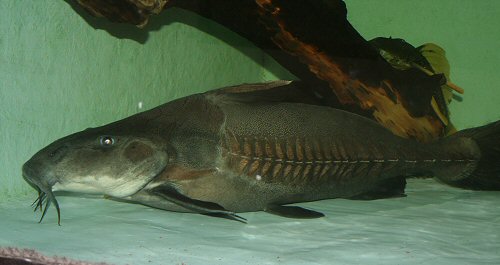
Common Name |
Mother of Snails Catfish, Ripsaw Catfish & Black Doradid |
Synonyms |
Doras niger, Doras humboldti, Pseudodoras niger, Corydoras edentatus, Rhinodoras niger, Rhinodoras prionomus, Rhinodoras teffeanus. |
Family |
Doradidae |
Subfamily |
Doradinae |
Distribution: |
South America: Amazon region, Peru, Brazil, Rio Purus, Rio Sao Francisco. |
Size |
In excess of 90.0cm (36ins) |
Temp. |
21-24°C (70-75°F) |
p.H. |
6.0-7.8. |
Hardness |
Up to 25 dGH |
Characteristics |
One of the main characteristics of the doradids is the presence of thorn like projections along the side of the body, which are known as scutes. These scutes are very sharp, so care should be taken when moving these fish. |
Colouration |
Occasionally amongst imports of Oxydoras niger there are the odd slightly different specimens which tend to have black coloured fins and a grey coloured body, which are Oxydoras sifontesi Fernández-Yépez, 1968. |
Aquarium Care & Compatibility |
| A real “Tank buster” if ever there was one. Quite a character obviously suited to large accommodation especially if keeping a number of fish together. Peaceful towards other fish and members of its own kind. Other doradids such as Agamyxis pectinifrons (Spotted Dora), Platydoras armatulus (Striped Dora), Oscars and any other fish of a compatible size. Large pieces of bogwood and clean plastic drainpipe of suitable diameter for them to hide under. Ideally heater guards should be provided in order for the fish not to burn themselves. |
Reproduction |
As yet unknown. |
Sexual Differences |
There are no known external sexual differences. There are however some thoughts and suggestions that there may be some differences in the shape of the bony plates which extend from the head to the edge of the pectoral fins. It has been suggested that the male has a more pointed plate, whilst the female has a more rounded plate. There is no scientific evidence that is available to support this observation. |
Diet |
| Readily accepts all manner of prepared foods. Stinking Sinking Catfish Pellets are high on the list, alongside floating pellets and sticks, as well as frozen bloodworm, chopped mussel and earthworms. |
Etymology |
| Oxydoras:
Oxys = sharp; doras = cuirass (
helmeted). |
IUCN Red List |
This species is evaluated as Least Concern given its wide distribution (IUCN 2022). |
References |
Previously published in the September 2005 edition of the Practical Fishkeeping magazine. |
Photo Credits |
© Allan James
@ |
 courtesy of
|

If you would like to contribute to the monthly factsheets with an article, information or photos, please e-mail me. You will of course be credited for your work.
If you would like to donate any denomination of money to the site just click the above link button. All proceeds will go to running the site and hopefully to keep it going for a few years yet.
ScotCat Sources
 Article
 Etymology-genera
Etymology-specific name
Online Sources
 Search
 Fishbase
 Wikipedia
 Catalog of Fishes
 GBIF
GBIF
 Fishnet2
 iNaturalist
 IUCN
IUCN

