SCOTCAT.COM
your internet guide to all things catfish
FACTSHEETS: October 2008 - no. 148
Liosomadoras morrowi Fowler, 1940 |
Liosomadoras
morrowi
In 1940, Fowler described a new species from Peru, Liosomadorus morrowi, and placed it in the Doradidae family even although it did not have the bony scutes that this family possess, but it had the spiny humeral process of this family. In 1978 an article on Liosomadoras oncinus with illustrations appeared in the TFH magazine by Martin Brittan and it alerted the Ichthyologist, Mees, who subsequently published a paper on oncinus. Mees noted that the fish in the article, which was mooted as a Centromochlus species, looked very like the original description which was discovered in Brazil by R. H. Schomburgk in 1841. He obtained specimens from Brittan and also the type specimen of our factsheet subject, L. morrowi and concluded, incorrectly, that they were one and the same fish and placed it in the Doradidae family. It was not until 1994 that these two species were considered as separate and they were placed in the Auchenipteridae family. This species is the exact opposite of the beautifully marked oncinus, and in the aquarium, just like its congener you may not see too much of it as it can be crepuscular in nature and will need hiding places to make it feel more secure and happy in its surroundings.
The authors - Liosomadoras morrowi
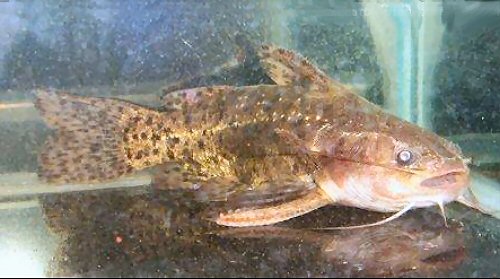
Above is my Liosomadorus morrowi, the Black Jaguar Catfish. I was given this fish by a friend who had bought it as a Jaguar Cat and did not know what it was. You may find the common name of the Black Jaguar Catfish misleading from this picture, but this photo was taken on the show bench and it had lost the dark markings that you will find when it is settled in your tank set up.
|
 e concentrate this month
(Oct. 2008) on a not to common species from
the Auchenipteridae family and a close relative to
its congener
e concentrate this month
(Oct. 2008) on a not to common species from
the Auchenipteridae family and a close relative to
its congener 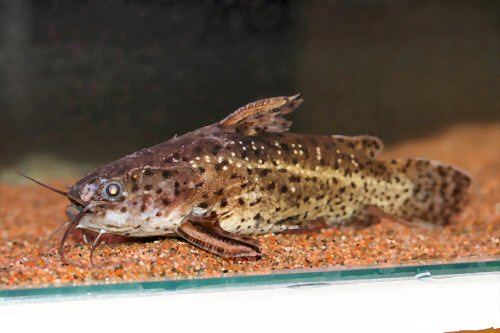
Common Name |
Black Jaguar Catfish |
Synonyms |
None |
Family |
Auchenipteridael |
Subfamily |
Auchenipterinae |
Distribution |
South America: Peru, in the Rio Ucayali basin. Type locality: Ucayali River basin, Contamana, Peru. |
Size |
16.0cm. (6¼ins) |
Temp. |
20-24°c (67-75°f.) |
p.H. |
6.5-7.0 |
Characteristics |
Body short and compact with a compressed caudal peduncle. Head, large and broad, its width at the clavicles greater than its length. The long humeral extension has small spines and the barbels are thin and filamentous without branches. Dorsal spine has teeth on anterior and posterior edges. Pectoral spines have outer and inner margins strongly denticulated. Adipose fin is the same length as the anal fin, ventral fins short and positioned nearer the anal fin than the pectoral fin base. Caudal fin emarginate. |
Colouration |
Blackish/brown body with gold lateral line interspersed with gold and black spots. Underneath body, gold with black spotting which can extend into the head area. Unpaired fins with black spots. Can tend to change its body colour from dark to light according to the substrate. |
Aquarium Care & Compatibility |
| Can be kept in a community tank but may eat very small fish at night such as the fry of livebearers, but basically a good addition to the larger tank set up. My speciman is kept in a 48" x 18" x18" with a large Synodontis nigrita and a Pike Cichlid, so it has plenty of room. I don't see it very often, only If I am rearanging the tank layout. Can be territorial with its own kind but you can get round this by providing extra cover such as pipes and driftwood. |
Reproduction |
There are no known reported aquarium spawning's of this catfish but can be sexed due to the thickening of the anterior of the anal fin, as is the norm in this family, akin to the anal fins of the males of the Goodiae family of livebearers. |
Diet |
| Will take most prepared foods such as frozen bloodworm, tablet and flake food. Better to feed at night after lights out, but once settled in tank will forage for food in low light conditions. |
Etymology |
| Liosomadoras:
From the Greek leios, meaning smooth; soma; meaning
body and Doras (a genus of doradid catfishes); in
reference to the lack of bony plates on the body (when
the genus was described as a doradid). |
References |
Finley, Lee. Catfish Corner, The Jaguar Catfish, Tropical Fish Hobbyist; Aug.1997 p104-108. |
Photo Credits |
Top:
© Daniel
Blom |

|

If you would like to contribute to the monthly factsheets with an
article, information or photos, please e-mail
me. You will of course be credited for your work.
If you would like to donate any denomination of money to the site just click the above link button. All proceeds will go to running the site and hopefully to keep it going for a few years yet.
ScotCat Sources
 Etymology-genera
Etymology-specific name
Online Sources
 Search
 Fishbase
 Wikipedia
 Catalog of Fishes
 GBIF
GBIF
 Fishnet2
 iNaturalist

