SCOTCAT.COM
your internet guide to all things catfish
FACTSHEETS: July 2008 - no. 145
Calophysus macropterus (Lichtenstein, 1819) |
Calophysus
macropterus
The Pimelodidae family in my opinion always seem to have the species that somehow look what catfish should look like , if you get my drift, and the "Vulture Catfish" is no exception with its sleek look and long barbels and of course its large mouth. Wolfgang in his article likened Calophysus macropterus to any shark species in the way it moves in the water and its eating habits. The common name of the "Vulture Catfish" complies with the bird species also, in that it will scavenge everything and anything, is very voracious, and has been known to attack the lines and nets of local Fishermen to get at there catches. It also has the repugnant reputation of eating human faeces alongside villages in the rivers where there is a human population.
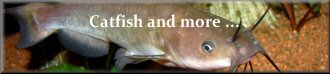
Calophysus macropterus - head view
I must admit that in the "Large Catfish" world this is probably one of the nicest looking and comparatively easy to keep species if you are a big cat enthusiast, and if you are able to give it a large tank to cruise around in. Wolfgang states that they can be kept with congeners, better with two or three and introduced together in the Aquarium as youngsters. This would precipitate having a larger tank of over 6ft (180cm) in length 2' 6" (75cm) depth and a width of 3' 0" (90cm) so you see this is a fish for the serious catfish keeper. This species is monotypic (only species in the genus) and as such the fins are different and there are differences in the teeth structure and a reduction in the swim bladder to other members of the Pimelodidae family. There has been calls to place this catfish in its own family but at the moment it is classed in the Pimelodidae.
|
 ver since I set my eyes on this species,
and the only time, was at a fish show that I was judging
at in the North of England in about 1998. It was small,
about 10ins in length and didn't gain an award, but
I have never forgotten it and my memory was jogged
once again by an article that was contributed to ScotCat
10 years later in 2008 by German aquarist and author,
Wolfgang Ros, which you can read
ver since I set my eyes on this species,
and the only time, was at a fish show that I was judging
at in the North of England in about 1998. It was small,
about 10ins in length and didn't gain an award, but
I have never forgotten it and my memory was jogged
once again by an article that was contributed to ScotCat
10 years later in 2008 by German aquarist and author,
Wolfgang Ros, which you can read 

Common Name: |
Vulture Catfish |
Synonyms: |
Pimelodes macropterus, Pimelodus ctenodus, Pimeletropsis lateralis |
Family: |
Pimelodidae |
Subfamily: |
- |
Distribution: |
South America: Amazon and Orinoco River basins. |
Size: |
50.0cm. (20ins) |
Temp: |
22-26°C (71-79°F) |
p.H. |
6.5-7.2. |
Characteristics |
The body shape is elongate and the head broad, its surface covered in skin. A wedge shaped fontanel extends from about the posterior nasal openings to the the posterior margins of the eyes and another circular one is present at the base of the occipital process. The eyes are superior in position. The barbels are flattened, the maxillary pair long, extending to at least to the end of the adipose fin and often extending beyond the end of the caudal fin. The first dorsal ray in the dorsal fin ray is not spinous, although in some individuals the base is about half as stiff as some spines of other species and longer than the succeeding rays. The adipose fin is long and the caudal fin is deeply emarginate. |
Colouration |
Silver/grey body with bluish undertones. The body down to the insertion of the pectoral fins has an irregular spotted pattern and there can be different patterns in different populations of this species. The belly is white. |
Aquarium Care & Compatibility |
| An out and out predator so should only be kept with larger species such as South American cichlids, Oscars etc. and the larger L-number armoured Loricariids. |
Reproduction |
Unreported. |
Sexual differences |
The males will be slimmer than the females. |
Diet |
| Shrimps, fish fillets and live foods such as Earthworms. Will gladly take tablet, pellet foods and foodsticks. |
Glossary of Terms |
Anal
Fin: The fin forward from
the anal cavity. |
Etymology |
| Calophysus:
Greek, kalos, kallos = beautiful
+ Greek, physa = tube. |
References |
Burgess,
W.E. 1989 An
atlas of freshwater and marine catfishes. A preliminary
survey of the Siluriformes. T.F.H. Publications, Inc.,
Neptune City, New Jersey (USA). 784 p. |
Photo Credits |
© Wolfgang
Ros @ |
|

If you would like to contribute to the monthly factsheets with an
article, information or photos, please e-mail
me. You will of course be credited for your work.
If you would like to donate any denomination of money to the site just click the above link button. All proceeds will go to running the site and hopefully to keep it going for a few years yet.
ScotCat Sources
 Article
 Etymology-genera
Etymology-specific name
Online Sources
 Search
 Fishbase
 Wikipedia
 Catalog of Fishes
 GBIF
GBIF
 Fishnet2
 iNaturalist

