SCOTCAT.COM
your internet guide to all things catfish
FACTSHEETS: July 2007 - no. 133
Brochis britskii Isbrücker & Nijssen, 1983 |
|
Brochis britskii belongs to the family Callichthyidae known as the Armoured Catfishes from South America. This catfish is documented as being found in the Upper Paraguay River basin, Bolivia and Brazil (see update at bottom of page).
Brochis britskii
Brochis britskii was named in honour of Dr Britski of the Saõ Paulo Zoology Museum in Brazil. Dr Nijssen first brought this catfish to the attention of catfish enthusiasts at the Catfish Association of Great Britain (C.A.G.B.) convention as far back as November 1983. Brochis britskii is not commonly available, but is well worth looking out for. I would suggest that you would expect to pay around £10.00- £20.00 (U.K. prices) per fish depending upon size. The tank I would suggest would be a minimum size of 36” x 18” X 18” for a small shoal of these magnificent catfish. I would suggest good quality aquarium sand such as BD Aquarium Sand, or very smooth rounded gravel as the preferred substrate when keeping these catfish. The aquarium should provide some shelter in the form of rocks or bogwood along with a small covering of aquatic plants, although this is not essential. As with all other species of fish, water quality and general husbandry is very important, and I would recommend that a minimum of 25% water is changed on a weekly basis.
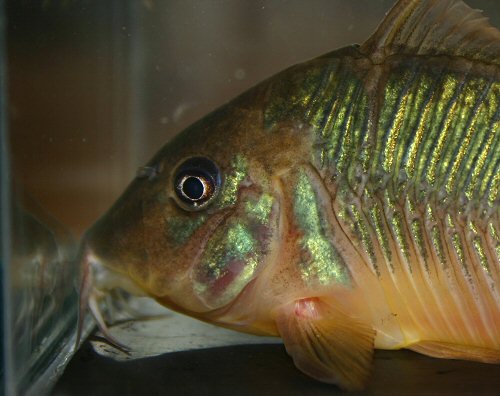
Brochis britskii - close up of head
Brochis britskii prefer to be kept in water which has a pH in the range of 6.5-7.2 and hardness in the range of 0-12ºdGH. This catfish is ideally suited to temperatures in the range of 20-24ºC. These catfish are documented as being found naturally in slow flowing weed-choked rivers. UPDATE (2020): Brochis was synonymised with Corydoras by Britto in 2003 but in time there will be a revision which will resurrect Brochis (Cope, 1871) to full genera again so in the meantime we are sticking with Brochis as there is marked differences with the both genera. Brochis is included in Lineage 8 (sub-clade 1) with the "intermediate long-snouts" with deeper bodies.
|
 ur
resident catfish expert Chris Ralph returns this month
to complete the trio of Brochis species on
the factsheet list with a look at the Giant Brochis,
Brochis britskii. I
now hand you over to Chris.
ur
resident catfish expert Chris Ralph returns this month
to complete the trio of Brochis species on
the factsheet list with a look at the Giant Brochis,
Brochis britskii. I
now hand you over to Chris.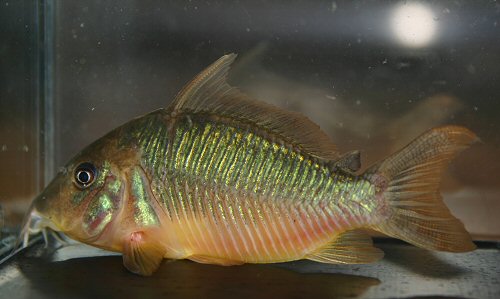
Common Name: |
None |
Synonyms: |
Giant Brochis, Britski’s Catfish |
Family: |
Callichthyidae |
Subfamily: |
Corydoradinae |
Distribution: |
South America: Brazil, Paraguay (upper Rio Paraguay). |
Size: |
85mm s.l. (standard length – this is the measurement of the fish from the tip of the snout to the base of the caudal peduncle). |
Temp: |
20-24°C (67-75°F) |
p.H. |
6.5-7.2. |
Hardness: |
0-12ºdGH. |
Characteristics |
The body shape of Brochis britskii is described as almost being deep bodied with a typical triangular shape as with its close cousins the Corydoras. Brochis britskii is described as having a short rounded snout. The dorsal fin has 15-18 soft rays although it is more usual to have 15 (in comparison Brochis multiradiatus has 17 whilst Brochis splendens has 12). The head is described as being covered ventrally by a large shield which reaches beyond the tip of the mental barbels. Brochis britskii has two pairs of rictal barbels and one pair of mental barbels. The inner edge of the pectoral fin spine is described as being weakly serrated. |
Colouration |
The base colour of the body and head is pinkish tan. The dorsolateral body scutes are described as having bluish or greenish metallic colouration. The ventrolateral body scutes are described as being pinkish tan in colour. The dorsal, adipose, pectoral, ventral and caudal fins are tan in colour. |
Aquarium Care & Compatibility |
| Brochis britskii is an ideal addition to an aquarium containing fish such as South American dwarf cichlids, tetras and small barbs, just as long as the other occupants are not too aggressive. |
Reproduction |
There have not been any reports of successful aquarium spawnings of Brochis britskii, although it is thought that they will breed in the same way as Corydoras. |
Sexual differences |
There are no documented sexual differences, although it is generally thought that when in breeding condition the female will be larger and fuller bodied than the male when carrying eggs. |
Diet |
| Brochis britskii readily accepts a mixed and varied diet which includes sinking foods such as catfish pellets, tablets and frozen bloodworm. These catfish benefit from the addition of some meatier foods in their diet such small or chopped earthworms. |
Glossary of Terms |
Dorsal:
is defined as top or above. |
Etymology |
| Brochis:
A sling which is a reference to the structure of the
barbels; from the Greek meaning inkhorn in reference
to the fact that this catfish resembles one. |
Photo Credits |
| Images: Chris
Ralph |
|

If you would like to contribute to the monthly factsheets with an article, information or photos, please e-mail me. You will of course be credited for your work.
If you would like to donate any denomination of money to the site just click the above link button. All proceeds will go to running the site and hopefully to keep it going for a few years yet.
ScotCat Sources
 Etymology-genera
Etymology-specific name
Other Sources
 Search
 Fishbase
 Wikipedia
 Catalog
of Fishes
Catalog
of Fishes
 GBIF
GBIF
 Fishnet2
 iNaturalist

