SCOTCAT.COM
your internet guide to all things catfish
| Collecting in the Paraná River Basin, Argentina (Part 1) |
by Haraldo & Noemí Bishop Edited by Allan James |
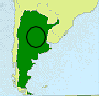
South
America Argentina Paraná
River basin
Last February I went fishing with my wife to the Paraná river, in a place that we had never been before, when we threw the nets on the water we caught various little fishes, at first we believed that we had caught Hypostomus plecostomus, which is very common here, but a second look showed that we had another species of loricariid. We took the fishes to our home and raised them in a 120 l. aquaria (about 26 UK gallon). Then we searched for information about them. We had no luck, we could not find any information, no photos, no name, or no description, so we contacted Allan at www.scotcat.com to try and find out what species this was and this led us on to a friendship which has blossomed and has cumulated in this series of articles which I hope you will all enjoy. Now ( July 18, 2004) the fishes are 55 mm (about 2 inch) of total large, when we caught them they were 25 or 30 mm (about 1 inch). We feed them with a home made mix that is made with lettuce, peas, carrots, soja floor and a bit of cat food, for the taste. The fishes enjoy this food and take it eagerly, and with this food they seem to grow fine. I did not know the adult size of this species so I asked the people who live near this place, but they do not seem not to know these catfish. In the wild the enviroment was a sand and soil mix, the water pH was neutral and the water was turbid, but no too much (The Paraná river water is never clear). The air temp was about 33 ºC. Allan has replied on the identification of this species and below are his comments. <I have had a reply back from Jon Armbruster of the Auburn University Museum Fish Collection, and he is quite sure that it is a juvenile Hypostomus cochliodon from the H. cochliodon group. They have spoon shaped teeth when adult but may not show this trait yet on your specimen. He also mentions that he has not seen such big spots on a juvenile before so I'm guessing that this species from your area of the Paranà River must have this trait , as the specimens that are described are usually from Paraguay. When reaching adulthood there are more spots and they get smaller, and more spread out.> Click on thumbnails for larger image. Hypostomus cf. cochliodon (juvenile)
We caught another
species in the same area as the Hypostomus cochliodon,
a species that we thought looked like a Panaque
species. Indeed it looks similar, but not the same,
in form and colour to Panaque L204-flash pleco-
or a Panaque maccus-clown pleco. Where we caught
this species was only This second pleco
actually turned out to be a juvenile
Hypostomus latifrons (L 051,
L 281) and is also native to Paraguay. This species
as it Click on thumbnails for larger image. Click on your Web browsers back button to return to this page. Hypostomus latifrons (L051, L281) (juvenile)
The third species
that we could not identify is a pleco that looks like
a Pterygoplichthys. We caught it in February
2003, when we took it to our From the first moment it loves wood, it spends the time over a submerged branch, and its growth rate was so fast that if we look attentively we can see it grow continually. In a few days the tail had filaments and were pointed and the fishes continued growing and the colour become a bit clear. They continue growing fast after about a year, and then its growth rate slows down. The most species of plecos are nocturnal or crepuscular species, in occasions quite shy, but these are active all day and are not shy. At this time it has grown to 150 mm (about 6") and its growth rate is much more slow now. We see specimens about 250 mm (about 10 "), we don't know if there are more larger specimens. We were right in
the assumption that it is a Pterygoplichthys
species, namely Pterygoplichthys ambrosettii.
The genus name has now been reclassified back
to Pterygoplichthys from Liposarcus
due to the work carried out by J.W. Armbruster
2004.
We caught this Pterygoplichthys ambrosettii in two diferent sites. The first one was in the same Paraná river, near (3 to 4 miles) from the site where we caught H. cochliodon and H. latifrons, but this site was much more densely planted, the river was in high level and the water had flooded over the grass in the low banks. In this submerged grass we catch Rineloricaria sp. Corydoras paleatus and Corydoras hastatus with lots of juvenile Hypostomus plecostomus, Characins (Aphyocharax anisitsi, Hemmigramus sp. etc) and a few juvenile Crenicichlas. The other site was a ditch that is barely 40 cm (16 inch) width and was 15m (45 ft) from a little creek. This creek finished in the Paraná River about 1 mile from this point. In this site we also captured Gymnogeophagus rhabdotus and a Characin, Phyrrulina sp., similar to Copella arnoldi, the splash tetra, and also various juvenile H. plecostomus. We did not know the water temperature, (the air temp. was about 33ºC) but we guessed about 28 ºC. The pH in the first site was neutral, in the second site we guessed that the pH was more low, due to the submerged dead vegetation and some branches, the water temp. must be higher (about 30 ºC) due to the low water level directly exposed to the sun, and also the water was quiet, with no current due to a dead branch on the creek. The next species we have is a Sturisoma species, we captured this about 400 or 500 m from the site where we caught H. cochliodon and H. latifrons, in this place there was much more floating plants. The larger plants that we know as "camalotes", are very common in the Paraná River and some times form little floating islands. We caught two of this species, but the little one was almost a thread and did not survive. We see this catfish in the local aquaria shop, they are about 10 inches in adult size, but the colour and profile are the same as our fish, that was captured in February at 2.5 inch length and now is about 5 inch. We guess that is a Sturisoma aureum form, but the dorsal fin is different to the photos that we have. This species turned out to be Sturisoma robustum which also comes from the La Plata area further to the south and also to the north of us in the Misiones area, and may also be found in Brazil and Paraguay. Today all the water streams to our south in the La Plata zone are contaminated, it is very sad, but it is an actual reality. I know La Plata city and its surroundings to the north, I do not believe that there are many fish alive there, may be to the south ..... As I said, it is very sad. I hope this species lives on in other sites. Click on thumbnails for larger image. Sturisoma robustum
References: Armbruster, J.W, 2004. Phylogenetic relationships of the suckermouth armoured catfishes (Loricariidae) with emphasis on the Hypostominae and the Ancistrinae.
All Photo's by the authors. |
 his is the first in a series of
three articles on the collections carried out by the
authors in their native environment around the Paraná
River in northern Argentina near to the city of the
same name, (Paraná City), and also into the Misiones
province near Posadas city in the south west zone of
the province near the Paraguayan border. I will now
hand you over to Carlos and Noemi to take you through
their collecting experiences.
his is the first in a series of
three articles on the collections carried out by the
authors in their native environment around the Paraná
River in northern Argentina near to the city of the
same name, (Paraná City), and also into the Misiones
province near Posadas city in the south west zone of
the province near the Paraguayan border. I will now
hand you over to Carlos and Noemi to take you through
their collecting experiences.



If you would like to contribute an article, please e-mail me. You will of course be credited for your work.
If you would like to donate any denomination of money to the site just click the above link button. All proceeds will go to running the site and hopefully to keep it going for a few years yet.
Print or e-mail this article below


