SCOTCAT.COM
your internet guide to all things catfish
| A Jewel in the Aquarium called Pimelodus ornatus |
by Wolfgang Ros |
Pimelodus ornatus
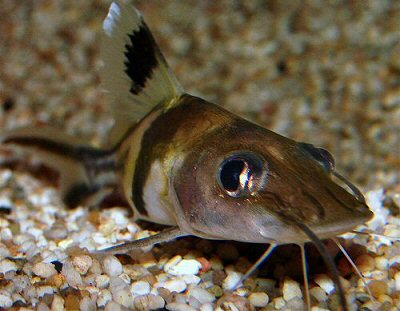
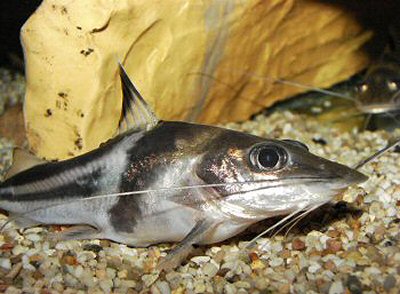
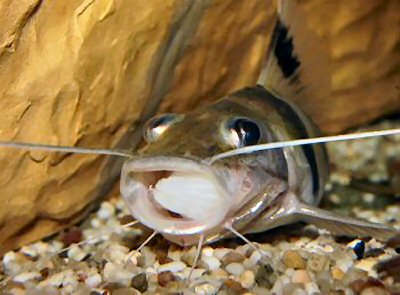
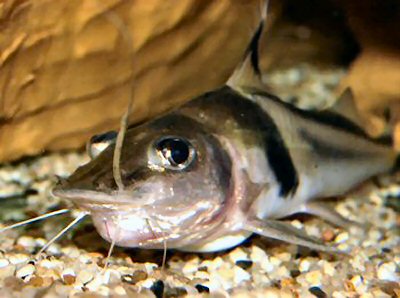
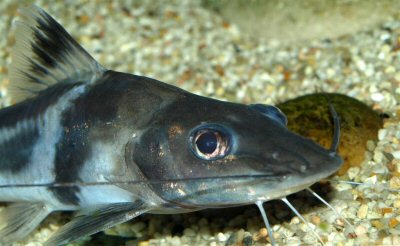
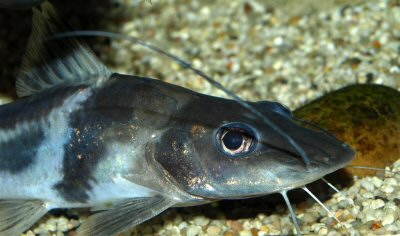
Description of species For P. ornatus the three black strips are characteristic, of which two run lengthwise along the collateral line respectively at the back and the third extends crosswise from the beginning of the dorsal fin up to the underside of the belly. In addition there is the black mark on the dorsal fin which is typical for this species. The top side of the smooth body is brownish to silver-grey, partly with a bluish shimmer, the belly is white. For a predatory catfish the long stretched slim shape appears really quite fragile. Completely in contrast to it stands the quite large head with its expressive eyes. Young specimens especially have a strong attraction to the viewer. All in all P. ornatus works a little like the “large brother“ of the well known and popular Pimelodus pictus. With specimens at first of equal length of both species a lighter size difference becomes visible after approximately two years. Then the longer and somewhat slimmer specimens turn out to be males.
Requirements for keeping P. ornatus is not particularly fast-growing, with good care however it can reach an age of over 20 years and in this time can become considerably large. In the wild animals of 40 centimetres and over have been caught. Aquarium specimens reach only a length to the also impressive 25 to 30 centimetres. Therefore, and because the species is often in motion, it fits only into tanks starting from approximately 500 litres capacity. The substrate should be gravel with a small granulation or better, sand. One should respect on a sufficiently free swimming area and at the same time with floating and larger specimen plants and one should also provide darker zones as possible retreats. If there are additional hiding places under stones, slates or roots, P. ornatus rapidly loses its initial shyness. Since the species originates from flowing waters, the water should be clear and with a high oxygen content. From there a stronger circulation pump provides the current as well as a good filtering. It is best to keep P. ornatus at a temperature of 24 degrees Celsius, with good ventilation occasional higher values are also tolerated. If the pH value lies around the neutral point and the hardness lies to 18° per degree of total hardness of water, according to German standards, and in addition weekly partial water changes to prevent bad water conditions, and with an involved impairment of the barbles, these conditions are optimal. When catching the animals some caution is required, because injuries can be caused by the pectoral fin and pricks from them can cause strong pain for a while due to secretions of poison. Aquarium observations My four specimens originated from Peru and are active during the day as well as dusk. As soon as they are hungry they will search the tank also during the day for any food. With both maxillary barbles extending behind the ventral fins and with the four smaller mandibular barbles the animals can locate all possible food on the ground, whereby one never sees them digging, so plants are not damaged. However the swimming movements of P. ornatus are to be described only rarely as being calm. With these rapid movements the cichlids from the genus Heros, which I had socialized from the beginning with the four P. ornatus, first had to get accustomed to this trait. At night the catfish due to their hectic and sudden movements with their barbles which enabled them good orientation worried the cichlids in such a way that several times they dashed around the tank hectically, but after a short time the cichlids got accustomed to the catfish and there has been no more incidents. Therefore for socialization, rather robust species are recommended. South American cichlids are applicable especially L-Catfish and Doradidae and also predatory catfish such as Sorubim lima or Hemisorubim platyrhynchus. Territorial ambush predators such as Pseudopimelodus bufonius however are less suitable.
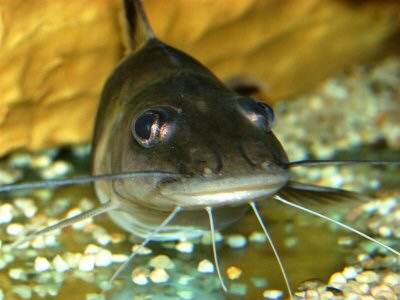
The shape of the snout is a typical identification
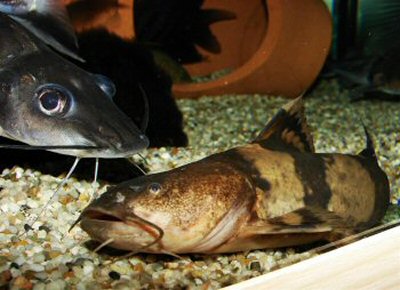
P. ornatus meets Pseudopimelodus bufonius
Smaller fish like the living-bearing Poeciliinae will be regarded as food from these predatory omnivores which devour what they can overpower, and disappear over night. The snout of P. ornatus with its pointedly running out flat snout is not able to separate smaller pieces from a bigger piece of food, however it can directly take up amazingly large portions. After devouring, P. ornatus then takes his time and as with the really large predatory catfish it indicates the associated efforts even hours later by an increased respiration rate, so if one wants to avoid losses with its keeping in the community aquarium, the socialized fish should be parallel to the growth of the catfish and exhibit at least one third of their body length. Substrate living fish should be even half as large so that they can exist together with P. ornatus in the longer term. If then beside the usual meals, the catfish is fed additional foods at least once in the week with larger piece of food, nothing stands in the way with socialization.
P. ornatus can devour quite big pieces of fish!
The species accepts without any problems a conventional mixed food diet. At least until freshly imported animals have acclimatized themselves, some weeks will pass in which they completely refuse mixed feeds and therefore the keeper, for a transition period preferably and only after switching the lighting off, should offer younger specimens live foods such as red mosquito larvae (if need be frozen) or medium sized earth worms. Afterwards you can feed smaller off-cut pieces of fish such as, Tilapia filets, or from trout. As soon as these pieces of fish are in the water, P. ornatus immediately takes up the smell traces and starts to search for the food frenetically. Only later one can try it with mixed feeds such as FD-tablets or sticks. Pellets for sturgeon or trout, which this catfish - if at all - however, takes this far less greedily.
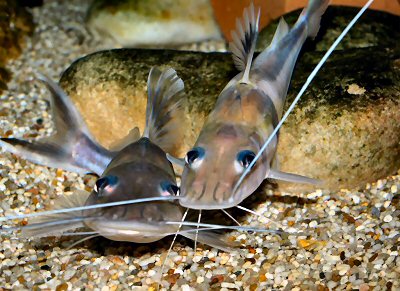
Rather the exception: two specimens close together
Here even the larger conspecific is bitten
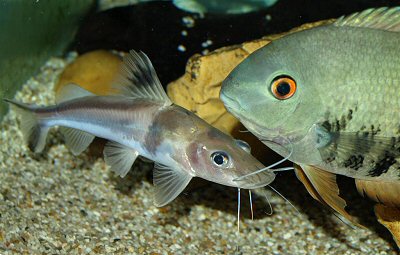
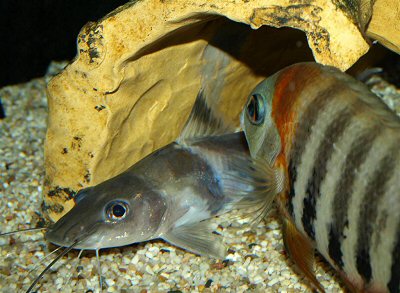
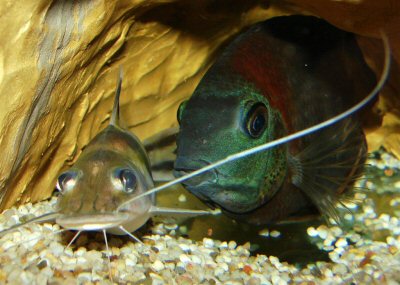
My specimens live with different South American cichlids of medium size very peacefully and share even their hiding places with them. Completely different is the behavior between each other. Even if younger catfish lie close together, then one finds already animals starting from 15 centimetres of length regularly in their own hideout. They show their territorial behavior by the fact that their own hiding place is defended with threatening gestures like lateral striking with the tail, and if also required very fast to smaller violent biting attacks against species conspecifics, thereby the beaten rivals can sustain clearly visible skin injuries up to bent barbles which fortunately heal rapidly and regenerate. Also outside of the hiding places each specimen seems to occupy its own area, more or less. So P. ornatus is not such obviously sociable and one can keep it also alone with a clear conscience. It may be that this catfish species is somewhat more active, if one keeps it in a small group, however it is questionable whether it feels better with these many frictions and in any case at least one hiding place must be available for each specimen.
Other species of sufficient size (here: Heros efasciatus spec. "blue“ and "red neck“) are tolerated even in the proximity of their own dwelling place. Sometimes catfish and cichlid share even the same hiding place
A very cheeky P. ornatus?
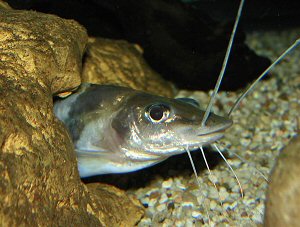
Once acclimatized the species is quite resistant and very hardy. If the catfish feel threatened or my Heros snatches at them, they give out a clear audible noise accompanied with the vibrating of the entire body, which deters the aggressor. In every detail these catfish register any disturbances outside of the aquarium, one moment spooking in the tank, and on the next approach they first disappear into their hiding place with their head out in order to observe immediately from there what is going on, and are very curious. When growing one finds them more frequently outside of their hiding places. The more hungry they are the more attention they pay to their keeper. Each animal has its own personality, and so it was easy for me after a short time to be able to differentiate the specimens which are slightly different due to certain behavior peculiarities from each other. They have the appearance for me that they are more active but also more tame since I had created additional hiding place possibilities by artificial caves at the tank sides. If I feed their favourite food, they purge into a kind of food frenzy, then the catfish devour greedily the large earthworms even from my hand and their bellies swell to a considerable size. On this food however the animals can live without further food for some days.
Well acclimatized animals take food even directly from the hand of the keeper
Hopefully an aquarist will be able to report on a breeding in the aquarium. This could be someone who is keeping a small group of approximately five animals on a long period in a tank of the size of a public aquarium and additionally will try to imitate the natural changes in the rain time like larger fresh water supply, change in the water level and so on. Allegedly the species breeds by internal fertilization and the female places the fertilized eggs on stones and plants.
With older specimen of P. ornatus the bluish glow shows more clearly
P. ornatus in profile: A catfish for loving!
Result P. ornatus is peaceful and attractive and with correct socialization is a species recommended for the lover of predatory catfish which unfortunately is imported rarely. However interested aquarists can purchase them with specialized dealers at least on order. They should not be deterred from the comparatively high price of approximately 40 euros for a specimen 10 to 15 centimetres in length particularly since it can grow up over the years to be a very gorgeous looking animal.
This article was
originally published in 2008 in the German publication:
"Aquaristik”
(4): 54-57. For this version now some additional pictures
were added by the author. Our thanks apply here to Ulrike
Wesollek-Rottmann, the publisher’s editor, and
Harro Hieronimus, editorial journalist "Aquaristik”,
who gave us kind permission to publish this article
on ScotCat.
|
 ith
some predatory catfish species it surprises me why they
are not more popular. Pimelodus ornatus which
is native to many streams of northern South America
belongs to this group. Because this species of the large
family of the Pimelodidae has a comparatively acceptable
final size, is less predatory and quite active. In addition
it looks good, so within the genus Pimelodus
it takes all the honours for its name as a “pretty
boy”.
ith
some predatory catfish species it surprises me why they
are not more popular. Pimelodus ornatus which
is native to many streams of northern South America
belongs to this group. Because this species of the large
family of the Pimelodidae has a comparatively acceptable
final size, is less predatory and quite active. In addition
it looks good, so within the genus Pimelodus
it takes all the honours for its name as a “pretty
boy”. 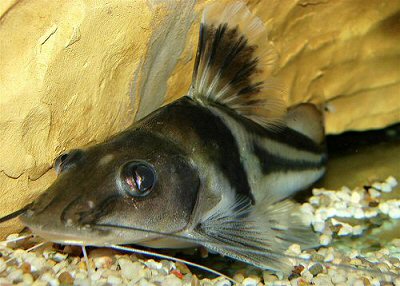




If you would like to contribute an article, please e-mail me. You will of course be credited for your work.
If you would like to donate any denomination of money to the site just click the above link button. All proceeds will go to running the site and hopefully to keep it going for a few years yet.
Print or e-mail this article below


