SCOTCAT.COM
your internet guide to all things catfish
| Cephalosilurus nigricaudus and its similarity to C. apurensis |
by Wolfgang Ros |
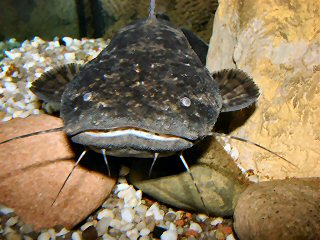
Striking are the similarities of C. nigricaudus with C. apurensis which is the most frequently imported species of this genus. Can distinguishes be crystallized out?. Probably because they are so dark and frowning, these plump, little catfish every now and then are assigned to C. fowleri which is notorious for its aggressiveness and is a third Cephalosilurus species apart from C. albomarginatus, which has not been introduced to aquarists yet. Primarily here however no mistake is possible, because apart from the brighter colouring, C. fowleri is to be identified clearly by its slimmer shape and the flatter head.
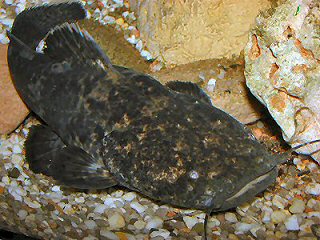
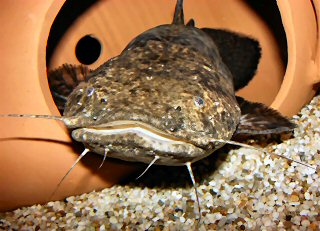
C. nigricaudus of 15 cm length with its typical juvenile colouring
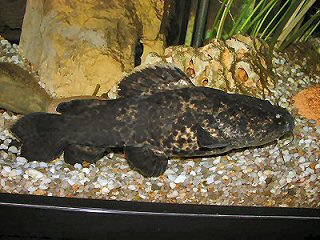
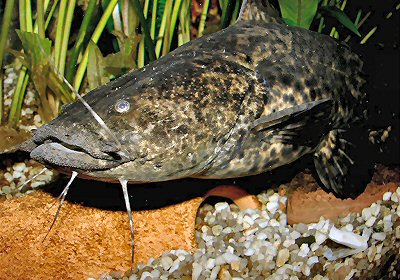
C. nigricaudus of 35 cm length: Caudal fin and tail are still nearly black
The Latin name “nigricaudus” means “black tail”, and indeed already with young specimen of C. nigricaudus the very dark colouring of the caudal fin is remarkable. On the other hand according to personal information from the Brazilian ichthyologist Dr. Oscar Shibatta (Londrina) who is scientifically occupied with the Pseudopimelodidae, and also with young specimens of C. apurensis, the caudal is quite dark. So from this conclusion, one of the two species can be told apart. At present I keep two with the figuration and colouring nearly similar in both specimens, of which one came from a private sale and the other one was acquired from Tropic-Aquaristik as C. nigricaudus. A comparison with one from Aquarium Glaser GmbH bought by another aquarist approximately two years before as, Pseudopimelodus nigricaudus which agreed was complete in form, colouring and behaviour. At first sight they are quite similar to my C. apurensis. By the way with regard to price there’s not much of a difference; as young animals they both can be bought starting from approximately 60 euro upward. So what now is common with both species and which is much more important for the enthusiastic keeper of these catfish, what are the differences? Here are some beginning possibilities: Habitat: Already the name of C. apurensis shows that this species is to be found in the Rio Apure of Venezuela. The habitat of C. nigricaudus is limited to Surinam. If asking the dealers the exact origin of these animals one mostly gets the answer that they were imported from Colombia or Venezuela. The exact habitat can only rarely be determined. If one comes to speak on Surinam then it is pointed out that at least at the questionable time no exports from there have taken place. A contradiction? Not necessarily, as a dealer confirmed, because catfish also from Surinam were imported from Venezuela. Besides it is questionable whether the actual area of circulation of C. nigricaudus is really limited to Surinam. Gill rakers: According to Dr. Shibatta the number of gill rakers (these are internal bony or gristly extensions of the gill arch) varies with C. apurensis to around 27 and with C. nigricaudus lies between eleven and 16. Since such a counting can be made only with dead animals, it does not really help the aquarist with the identification of his specimen. Colouring: Obviously there are differences in the colouring. Both species indeed have a remarkable juvenile dress by their black, partly in the form of stripes, arranged marks. The juvenile dress of C. nigricaudus however is altogether clearly more dark than of C. apurensis especially in the head area which is light brownish. The stripes are more on C. nigricaudus than with C. apurensis which are less clearly pronounced and are replaced later by points of different sizes and also with adult specimens of C. nigricaudus there remains by the multiplicity of the affect of marks something like a great big ribbon which drags on over the whole rear body region. With C. apurensis at 30 centimetres in length, the caudal fin and the tail are not so dark.
C. nigricaudus (top) and C. apurensis in direct comparison
Figure: Compared with its genus comrade, the body of C. nigricaudus is somewhat flatter and the rear third seems to be longer. C. apurensis particularly in old age seems so massive with its brawny head. Both species also have a little bit different muzzle form. Growth and final length: At the 40 centimetres mark C. nigricaudus as C. apurensis, bought as young fish of 15 centimetres in length, exceed to this size not later than in 18 months, afterwards growth slows down with both. Against the data of Fishbase one must assume with C. nigricaudus from a minimum length which is with half a meter, and the smaller of the two (according to Fishbase), C. apurensis, really reaches even 65 to 75 centimetres (cf. Fishbase-website of May 4th, 2008, where the maximal length of C. apurensis is indicated with 29 centimetres and for C. nigricaudus - in both cases male specimen - with 35 centimetres).
Behaviour: Actually as to the behaviour of my specimen of C. nigricaudus one could hit the nail squarely on the head in such a way that theythey love to hide itself and they eat wholeheartedly for their life. Basically both these attributes also applies to C. apurensis. Nevertheless, when keeping both species you will soon determine that C. nigricaudus is a bit more nocturnal, otherwise however it is more greedy. This is to be considered with its keeping, best in a tank with a capacity of approximately 800 litres upward. So it must be suggested that absorbed light and the supply of a hiding place which is appropriate to the body size. One is not dependent on giving live fish, the ambush-predator devours worms, shell meat and after habituation also fillet of fish in enormous portions. Therefore if at all one should socialise it only as a young animal with larger and in addition high-backed fish. At a temperature from 23 to 26° Celsius and otherwise "normal" water equivalents these species prove very durable. Blow the co-inhabitant, who comes too close for this, a good 45 cm long C. nigricaudus! Also in the behaviour for the keeper there are characteristics: C. nigricaudus needs more time for its acclimatizing and cannot as rapidly be tamed as C. apurensis, and if the food is given by hand, it shows itself as the more self-willed, more incalculable and thus in the long run also more snappy, with which one should act out with special caution. In relation to species and other genus comrades C. nigricaudus gives itself out as much more aggressive than C apurensis. With the entrance of sexual maturity it becomes feisty also in relation to other socialised fish of every species and size. If it cannot overwhelm and devour these, it becomes dangerous for them by its strong biting. Some observers would describe this behaviour as bad and mean, however it serves exclusively the purpose to drive away all further, and even if they are only potential one, food competitors out from their own territory. The species is even capable of attacking anything which is unprotected in the tank like heaters or pumps. I could observe with my larger, in the meantime nearly half a meter-long specimen, how it refused the right to exist to an additionally installed interior filter and how it struck out at it with such madness with its head against it until I had to remove it. All in all C. nigricaudus from the colouring is more attractive. It does not grow as large as its genus comrade but adjusts this however by its aggressive approach to its keeper and potential socialised fishes. So who is looking after the mysterious and incalculable and also fascinating should decide for this species. Who however enjoys a calm, to some extent reliable giant overeater, which is sensitive also towards heaters and pumps, C. apurensis is to be recommended. Editor update - December 2021: Cephalosilurus is now synonymized with Lophiosilurus so this species is now Lophiosilurus nigricaudus (Shibatta, Oscar A. et al, 2021) Literature: This article was published in February/March 2008 in the German publication: Aquaristik Fachmagazin & Aquarium heute (AF) 40 (1), Nr. 199: 34-36.
Our thanks apply here for
the AF-editorship and the Tetra Verlag GmbH (Dr.
Hans-Joachim Herrmann and Eckhard Grell-Herrmann),
who gave us kind permission to publish this article
on ScotCat. Mention must also be
made of our debt to Dr. Shibatta for the given details.
|
 n
the last years under the designated name "Pseudopimelodus
nigricaudus" there have been repeated introductions
of broad shaped catfish. Those have been 15 to 25 centimetres
long animals with the extra large head and the enormous
muzzle and assigned to four species so far in the genus
Cephalosilurus, which today is the valid name
for the earlier genus name Pseudopimelodus.
n
the last years under the designated name "Pseudopimelodus
nigricaudus" there have been repeated introductions
of broad shaped catfish. Those have been 15 to 25 centimetres
long animals with the extra large head and the enormous
muzzle and assigned to four species so far in the genus
Cephalosilurus, which today is the valid name
for the earlier genus name Pseudopimelodus.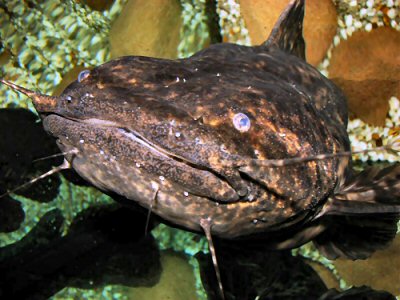

If you would like to contribute an article, please e-mail me. You will of course be credited for your work.
If you would like to donate any denomination of money to the site just click the above link button. All proceeds will go to running the site and hopefully to keep it going for a few years yet.
Print or e-mail this article below


